




As parents continue to feel pressures on their household budgets, increasingly skipping specialty clothing stores in favor of one-stop shopping at big-box giants like Target and Walmart, another children’s apparel retailer is closing stores.
Industry data confirms this shift, revealing that mass merchants now capture 80% of planned spending in the back-to-school category, according to Deloitte.
This shift in consumer spending habits, paired with the shrinking malls data, including projection from Capital One Shopping suggesting that up to 87% of traditional shopping malls could close over the next decade, has forced a number of mall clothing retailers to shut a number of underperforming locations.
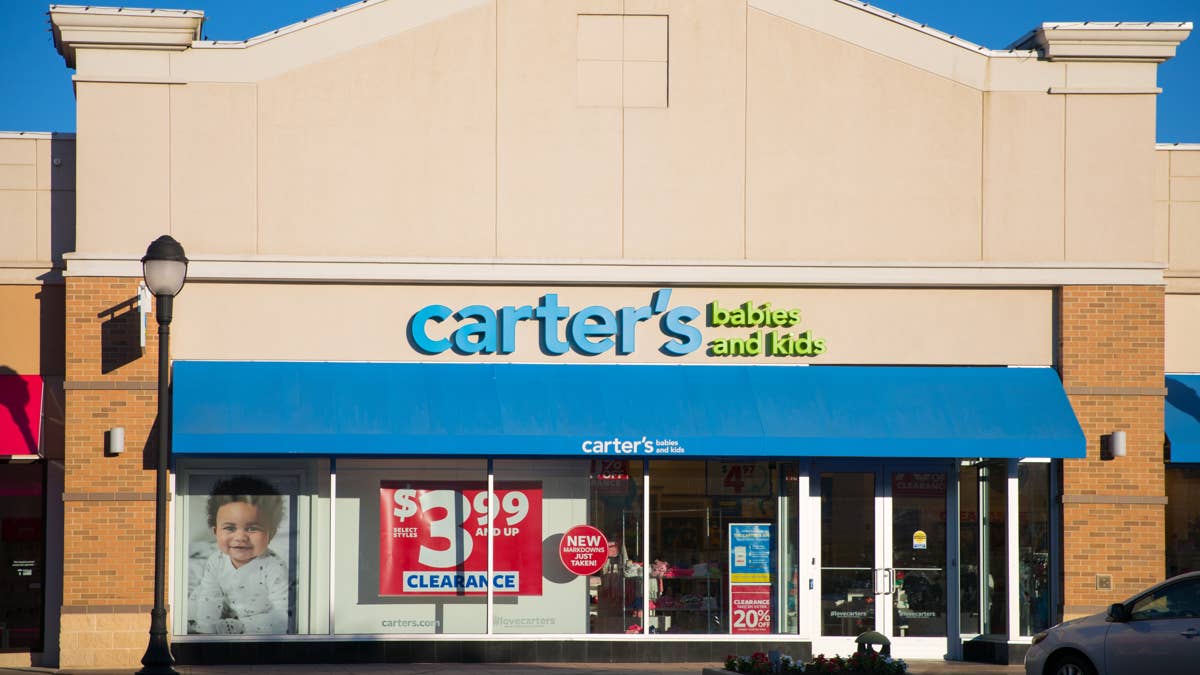
A mall staple The Children’s Place has shuttered hundreds of locations in recent years as part of a major restructuring plan to shed costly real estate, and legacy specialty chain, Carter’s, has started its wave of planned closures in 2025.
Carter’s closes 29 stores in the first two quarters of 2026
Founded in 1865, Carter’s grew from a modest Massachusetts knitting mill into North America’s largest children’s clothing maker by continually expanding its footprint and acquiring legacy brands like OshKosh B’gosh.
Over 161 years of its existence, Carter’s nurtured generations of parent loyalty with its offering and prices. Now, the kids’ clothing giant is strategically closing certain locations in an effort to stay at the top of its game.
During the first two quarters of fiscal 2026, Carter’s opened 4 stores and closed 29 stores in the United States, according to its Form 10-Q filing with the Securities and Exchange Commission (SEC).
As of July 4, 2026, Carter’s had 1,042 company-operated retail stores in North America.
Carter’s is closing stores, but shoppers are still buying
Carter’s shrinking store footprint does not necessarily mean shoppers are abandoning the brand. The company reported a 5.1% increase in comparable U.S. sales in the second quarter of 2026, marking its fifth consecutive quarter of positive comparable-sales growth.
However, the latest results came with important caveats. Nearly all of Carter’s operating income jump came from a one-time $128 million government refund of previously paid tariffs, not from stronger underlying profitability; stripped of that refund, adjusted operating income rose to $18.1 million from $11.8 million in the same period of 2025.
The company also narrowed its full-year outlook, and its stock fell more than 8% on the news as investors looked past the refund.
Carter’s Q2 2026 at a glance:
- Comparable U.S. sales up 5.1%
- Fifth consecutive quarter of positive comparable sales
- Operating income increased to $139.8 million, compared to $4.0 million in the second quarter of 2025, driven largely by a $128 million one-time tariff refund, and partially offset by new, ongoing tariff costs.
- Returned $18 million to shareholders through dividends in the first half of fiscal 2026
- Narrowed full-year outlook
- Source: Carter’s Q2 press release
Carter’s already announced 150 closures
Carter’s was also profitable in 2025, reporting net sales of $2.898 billion, up 2% from $2.844 billion in 2024, according to its fourth-quarter earnings release.
“2025 was a year of meaningful progress in stabilizing our business while responding to significant new tariffs. We took actions to right-size our cost structure and we launched several important initiatives to improve the productivity of our merchandise assortments and store fleet,” stated then-CEO Douglas C. Palladini.
In the third quarter of 2025, Carter started a cost-cutting program which includes a plan to close 150 stores, with closures spreading into 2028.
“Regarding productivity, we are addressing our cost structure across several fronts. On our last earnings call, we announced a portfolio optimization strategy to improve fleet productivity, including plans to close approximately 150 lower margin stores in North America through 2028,” Palladini said during the fourth-quarter earnings call.
In 2025, Carter’s closed around 35 stores as leases expired, with roughly 100 total closures expected for the year.
Despite these closing initiatives, Carter’s has found a way to continue to reach customers widely across the country.
Carter’s keeps betting on its exclusive lines at Target, Walmart
As parents continue to shop for value deals, and increasingly seek not only the most affordable retailers but also the most convenient shopping experience, Carter’s has found a way to meet those needs.
More than 20 years ago, in early 2000s Carter’s began launching store-exclusive lines to expand its reach through major mass retailers, such as Walmart and Target. The retailer has continued that practice offering several exclusive lines for major retailers, including e-commerce giant Amazon.
Exclusive Carter’s lines for major retailers:
- Target: Just One You by Carter’s – Designed exclusively for Target stores and online, offering lower-priced multipacks, layette items, and sleepwear.
- Walmart: Child of Mine by Carter’s – Distributed exclusively through Walmart locations and website, providing budget-friendly everyday baby apparel.
- Amazon: Simple Joys by Carter’s – Created exclusively for Amazon to capture high-volume online shopping.
Through these collaborations with retail giants, Carter’s isn’t losing customers entirely because of massive closures, as parents are simply buying Carter’s products while grocery shopping at nearby Target.
Thanks to these partnerships, Carter’s can focus on its cost-cutting strategy which includes closing high-rent standalone stores.
Related: Another outdoors retailer closing stores
Consumers continue to cut back on apparel and other discretionary purchases
Apparel ranks among the highest categories for planned consumer spending cuts. McKinsey consumer survey found net spending intent for apparel plummeted to –24, compared to just –1 during the same period last year.
“Consumers reported plans to pull back across a broad range of discretionary purchases. Of the 22 categories in our survey, pet care services was the only one with net spending intent at zero or above; every other category was negative,” reads the report.
Nearly three-quarters (72%) of consumers say they still have room to cut spending on discretionary categories such as dining, beauty and personal care, and apparel, according to the latest EY-Parthenon Consumer Sentiment Survey.
These cutbacks are happening as more than half (54%) of Americans report saving no money in June 2026, while one in five households spent more than they earned and relied on savings or debt to help cover expenses.
“For retailers, demand remains intact but increasingly selective, making value, affordability and clear differentiation more important than ever,” stated Will Auchincloss, EY-Parthenon Americas retail sector leader.
Related: 29-year-old casual dining chain closes 4 locations after acquisition